
Kaufman County Previous Residents by Era
Past-resident research changes with the period. A current parcel search provides the modern identifier and legal description. The County Clerk's remote index is an entry point for recorded instruments within its observed index-book period. Dated directories and newspapers add household or community clues. The county library, university collections, and Terrell local-history resources can take over when a web index is silent. These sources do not form one continuous list. The gaps are part of the research result and should be recorded rather than filled with assumptions.
| Source | Years it covers | Where held | What it can show |
|---|---|---|---|
| Kofile deed index books | 1902-1968 observed online coverage | Kaufman County-linked Kofile index; Clerk fallback | Recorded parties, instrument references, and book, volume, or page leads |
| Kaufman Sun | 1880-1905 | UNT Kaufman County Area Newspaper Collection | Dated notices, local events, names, and address or property leads |
| Forney Messenger | 1904-1992 | UNT Kaufman County Area Newspaper Collection | Full-text and image leads that need page-level review |
| Kaufman telephone-directory issues | 1955-1993, with issue gaps | UT Center for American History citation | Telephone subscribers in Kaufman, Crandall, and Kemp |
| Family files, cemetery records, interviews, and maps | Varies by collection | Kaufman County Library and Terrell genealogy assistance | Family and place context that needs source-specific verification |
For an address before the Kofile coverage, ask the County Clerk how to locate the appropriate earlier record rather than assuming that the online index is complete. For a later land-record question, ask whether a current online, counter, or copy route applies to the year in question. A deed is evidence of a recorded interest. It is not by itself evidence of who lived at the address.
Kaufman County Previous Residents Deed Chain
The Kofile Kaufman deed index supplies two paths: Index Books search by Type, Year, Parties, Last Name, and First Name, or document search by Book, Volume, and Page. Use CAD first to retain the property ID, geographic ID, situs address, and legal description. Those details make it easier to distinguish a similar street name or a later address change from the same parcel. The index is a finding aid. Its own remote access does not replace the instrument or a Clerk-certified copy.
- Find the parcel in Kaufman CAD and write down the legal description with the address and both identifiers.
- Search the current or known party in the Kofile index. Preserve the instrument type, execution and recording dates if shown, and the book, volume, page, document, or image reference.
- Read the instrument lead to identify the earlier party and search that party in the opposite role. Test initials, punctuation, surname variants, and married or maiden-name forms.
- Repeat backward only when the legal description continues to match the same parcel. Keep an unresolved discrepancy rather than forcing a chain.
- For a missing image, an earlier period, or a record needed as an authoritative copy, contact the Kaufman County Clerk with the party variants, legal description, date range, and reference number.
The Clerk's Real Property / Vital Statistics contact is at 1902 E US Hwy 175 in Kaufman, with 469-376-4730 and weekday hours of 8:00 a.m. to 4:30 p.m. The office is the appropriate fallback for an in-person search, mail request, e-fax, email, or certified-copy need. Ask for a fee estimate and specify whether a plain or certified copy is needed. The published county copy examples list plain copies at $1 per page and certified copies at $5 certification plus $1 per page, while directing readers to confirm the current charge for a particular real-property request.
Kaufman County Deed Record Terms
Land records use party roles and descriptions that should stay tied to the actual instrument. They are more reliable for tracking a parcel than a bare street label, particularly when a route, city label, or address assignment changed.
- Grantor
- The party transferring or conveying an interest in a recorded instrument. A grantor can be a person, estate, trust, company, lender, or public body.
- Grantee
- The party receiving an interest in the instrument. A grantee result is a lead to the prior transaction, not proof of physical occupancy.
- Chain of title
- A documented sequence of instruments affecting the same property. It must be checked against the legal description at each step.
- Legal description
- The lot, block, subdivision, abstract, survey, or other land description used to identify property more precisely than an address.
Keep the exact party role and the instrument reference in the research note. Reversing grantor and grantee, or losing a lot and block detail, can send a past-residents search to a different Kaufman County property.
Kaufman County Past Residents Telephone Issues
The UT Center for American History citation identifies Kaufman, Texas telephone-directory issues published by Gulf States-United Telephone System for Kaufman, Crandall, and Kemp. The observed issues begin with April 1955 and continue intermittently through 1993. The run includes many years from the 1960s through the early 1980s, then selected issues in the later 1980s and early 1990s. A missing issue does not mean a family or address was absent from the area.
The telephone-directory citation is shown by the UT directory collection.
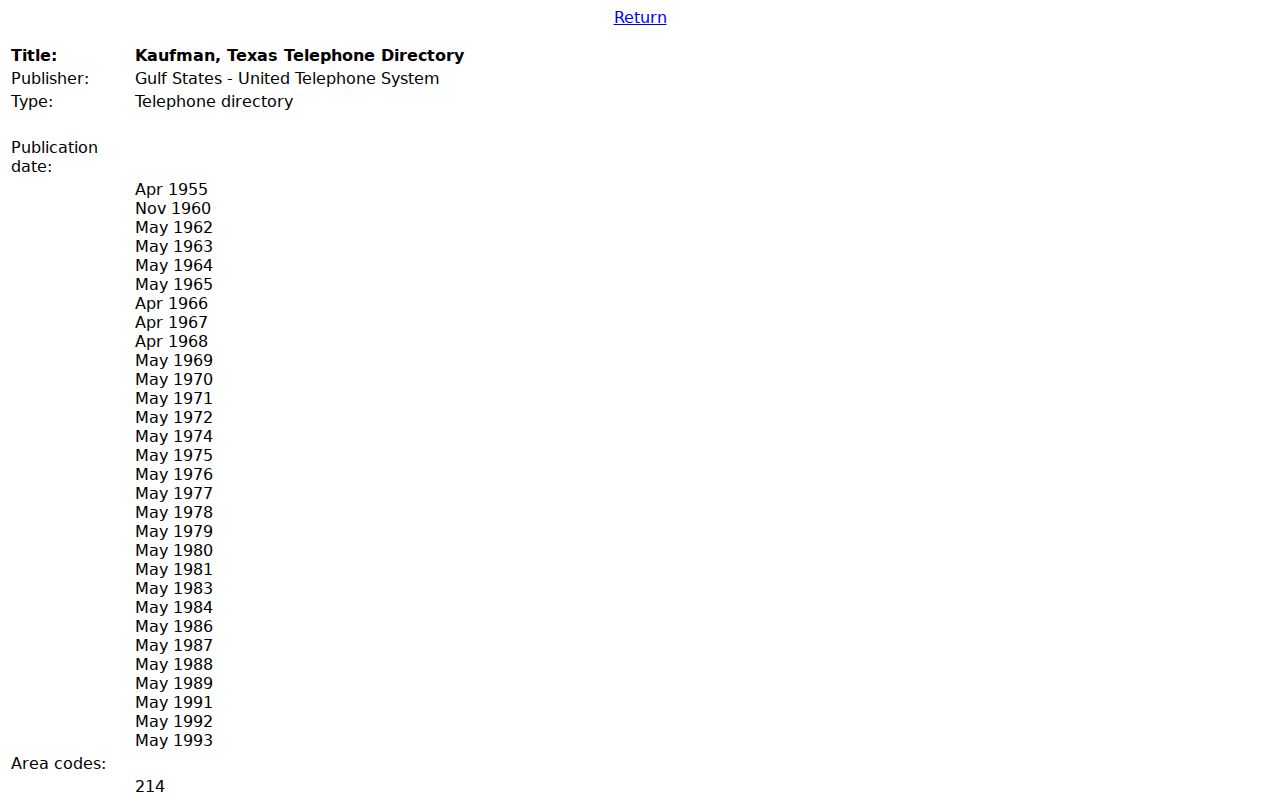
This capture supports the dates, publication identity, and place coverage of the telephone-directory lead. It does not establish a complete city directory, an address-arranged reverse directory, or the residence of every listed subscriber.
Use a directory issue as one dated signal. Capture its exact date, the printed name form, the page image if available, and the street or community wording. Compare it with the deed chain, newspaper image, or another primary source. The online research did not locate a verified Kaufman criss-cross directory run, so a library inquiry should ask for a specific title, year, format, and whether address searching is available.
Kaufman County Previous Residents in Newspapers
UNT's Kaufman County Area Newspaper Collection provides a strong dated layer for address history. It includes the Kaufman Sun from 1880 through 1905 and the Forney Messenger from 1904 through 1992. The collection supports Guided, Advanced, and Proximity searching across full text, metadata, titles, subjects, creators, and names. Search a surname with a place, street, business, school, church, cemetery, probate, estate, marriage, or obituary term, then inspect the newspaper page image.
OCR can misread both names and addresses. A hit should be logged with its paper title, issue date, page, image, search phrase, and the nature of the statement. An obituary may establish a death notice. A legal notice may show a property-related event. Neither should be converted into an unbroken residence timeline without corroboration. This is the household layer of a past-resident search, separate from the ownership chain.
Note: A newspaper result gains value when its image, date, and place wording are preserved beside the deed or directory lead it supports.
Kaufman County Past Residents Local History
Terrell's Genealogy Research Assistance identifies Terrell Tribune archives, local-history video and interview material, Texas Digital Sanborn Maps, HeritageQuest Online, and Fold3 Library Edition as research leads. These are useful when a Kaufman County address trail reaches Terrell or when a family, business, street, or historic structure needs local context. Confirm current access, licensing, and whether a collection can be searched remotely before relying on it for a request.
The available Terrell local-history lead is captured by the city genealogy resource.
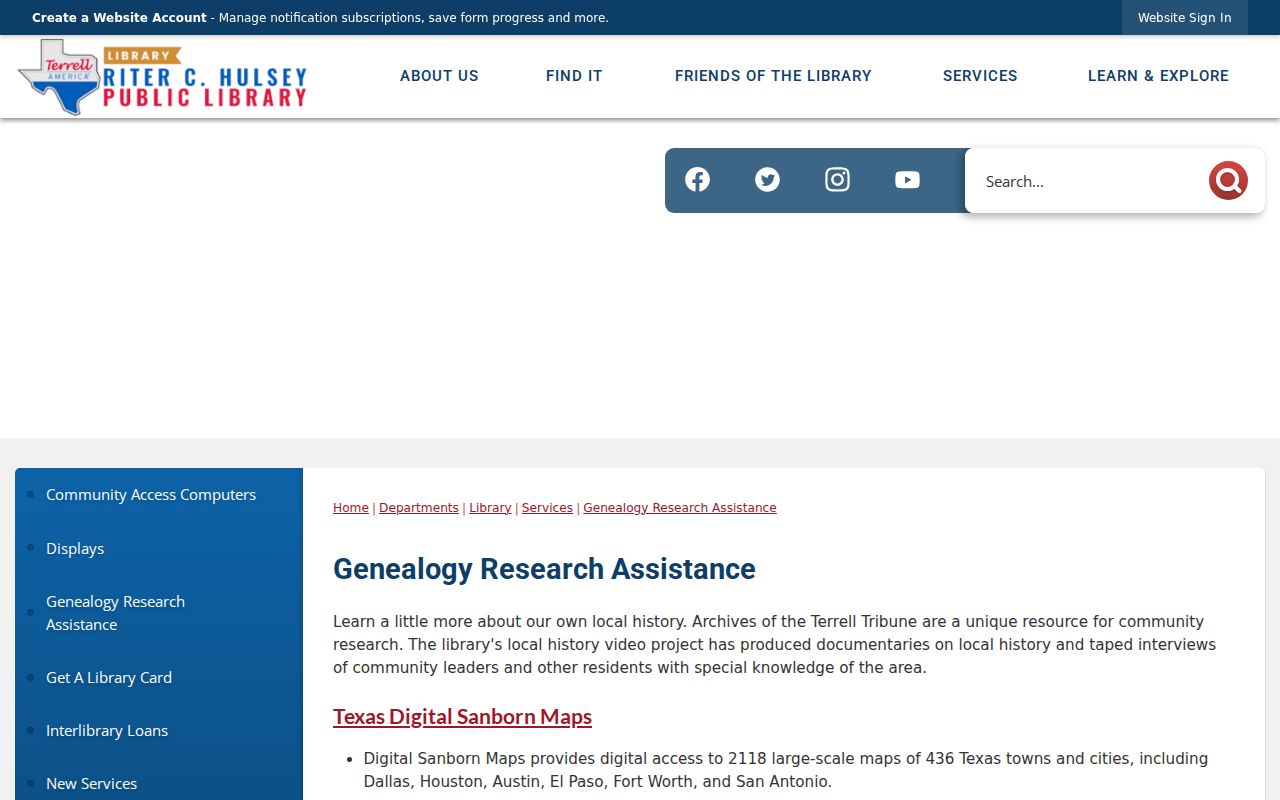
The image connects the address-history trail to the Tribune, interview, Sanborn, and database leads named by the city. A map sheet, oral history, or photo caption is valuable context, but none substitutes for a recorded instrument when the question is legal ownership.
The Kaufman County Library also links a genealogy area and is described by the Portal to Texas History as holding Kaufman County family files and cemetery records. Exact house-history guides, shelf lists, and reverse-directory coverage were not located in the reviewed official web text. Ask library staff for the collection title, date span, format, and access limit rather than promising a particular shelf or search feature.
Note: A local-history collection can strengthen a dated address trail, but its title, access rule, and evidentiary limit should remain in the note.
Kaufman County Previous Residents Household Pairing
A person or family should enter the past-residents trail only after the place and period are anchored. Pair each deed or address reference with a directory issue, newspaper image, census lead, or local collection from the same era. The Kaufman County city directories collection discussion focuses on the historical shelves and their limits; here the purpose is narrower: test whether a dated household clue belongs with the same parcel and period.
- Write the address exactly as it appeared in the record, then save the current normalized street form separately.
- Match the record date to the closest available telephone directory, newspaper issue, census resource, or local-history collection.
- Compare place labels, route numbers, subdivision or legal-description clues, and names without treating any one similarity as a match.
- Mark each item as a primary instrument, official index, archival finding aid, OCR lead, or unverified oral-history reference.
- Keep conflicting names, spelling variants, and street forms visible until a second independent source resolves them.
This process flow respects the limits of each source. A telephone listing may support a subscriber at a time. A newspaper can describe an event. A deed can establish a recorded interest. Pairing them carefully creates a historical trail without making a claim about continuous occupancy.
Note: Keep an original address string beside a modern normalized form so a route or street-name change does not create a false break.
Kaufman County Previous Residents Requests
The Texas Public Information Act provides a written route to existing government documents, subject to exceptions and special record rules. It does not require a custodian to research an open-ended question such as who lived at an address. For a deed-related request, send the County Clerk the legal description or PID, party variants, instrument category, and a bounded recording range. For an address-point, road-centerline, map, or permit item, ask Development Services for the specified existing record. The OAG request guide recommends clear dates, record categories, and a preferred format.
Request inspection, an electronic copy, a plain copy, or a certified copy as appropriate, and be ready for a clarification or cost estimate. Do not supply a full Social Security number, driver-license number, or protected address to make a request more specific. A parcel ID, instrument number, case number, or event date is usually the safer research identifier.
Kaufman County Address-History Limits
Previous residents, past residents, and people who lived here before are historical research phrases, not permission to build a dossier about living people. A house-history record should report the source and its date, then stop at the fact supported by that item. Do not expose protected voter fields, private contact details, substitute addresses, victim information, or real-time location data. Texas confidentiality rules can apply even where a related name or property record is public.
When a record conflicts or a current claim matters, return to the official custodian. Record limits and uncertainty are part of a careful house history. They are not gaps to fill with inference.